Studio Agate has announced an upcoming Kickstarter project for a new edition (3rd) of the fantasy swashbuckling role-playing game, 7th Sea. I have no experience with the game in any edition and have never read it, but it has been a popular topic of online discussion amongst a subset of gamers for years. Click here for more information.
Showing posts with label role-playing games. Show all posts
Showing posts with label role-playing games. Show all posts
20 January 2026

24 February 2024
Fudging Blades
"Fudging Blades: Swashbuckling Combat for Fudge!" (from SpiritMusketeer's Blog) is a simple swashbuckling combat system for Fudge by Thijs Krijger and Jay Shaffstall with help from François Letarte. It lacks the detail of simulationist fencing rules, but it appears to be relatively fast-paced. It looks promising.
[This article has been cross-posted here in Creative Reckoning.]
01 December 2022
Zorro: The Roleplaying Game Resources
If I have one criticism about Zorro: The Roleplaying Game, it's that it lacks a separate character sheet. The rule book has one, but it's part of the book, not a separate sheet that would be easy to photocopy. There's a PDF of the character sheet, but it's only available if you buy the PDF of the rule book. Thankfully, there are several free versions of the character sheet floating about the Internet, and here are links to two of them:
The second link also includes custom and vintage maps of colonial California and other useful information for anyone running Zorro: The Roleplaying Game adventures.
30 August 2022
The Treasures Ye Seek Be RPGs!
The Blog of Exalted Deeds has an article that might be useful to readers of Theoretical Swashbuckling: namely, Role-Playing Games Set in the Early Modern Period (ca. 1500-1800). This will be especially useful for my How to Be a Swashbuckler series and my personal collection of swashbuckling games.
09 January 2022
How to Create a Swashbuckler in Privateers and Gentlemen
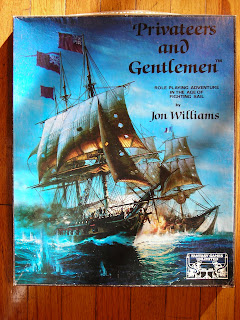
Privateers and Gentlemen, published by Fantasy Games Unlimited in 1982, is a game of "Role Playing Adventure in the Age of Fighting Sail" wherein "The world of Horatio Hornblower and all the naval heroes of fact and fiction is thoroughly dealt with in three volumes of rules."
As it states in the first volume, Promotions and Prizes:
PROMOTIONS AND PRIZES is a historical role-playing game. Each player will take the part of a naval officer of the period 1755-1815, attempting to rise in rank and affluence through a series of naval battles, raids, skirmishes, and captures... meanwhile avoiding any number of horrible deaths, diseases, amputations, courts-martial, or perhaps being shot by a firing squad like Admiral Byng.
Here is my first character for Privateers and Gentlemen:
Name: Captain Barrington Dalrymple, Privateer
Strength: 16Sense Acuity: 13
Mass: 11
Constitution: 15
Intelligence: 15
Dexterity: 8
Intuition: 12
Charisma: 11
Strike Bonus: +20%
Shoot Bonus: +5%
Parry Bonus: nil
Languages: 3 (including native tongue): English, French, Spanish
Handedness: right-handed
Social Level (of father): Gentleman (roll of 79)
Legitimacy: Legitimate
Position: First Son
Father's Health: Alive
Allowance: 25 pounds
Patrimony: 1000 pounds + Respectable Estate and House
Privateer Background: Smuggler + Merchant Captain
Gunnery: +15%
Sailing Ability: -5
General Seamanship: +10%
Astronomy: 15
Biology: 1
Carriage Driving: 14
Chemistry: 1
Climb: 10 (raised from 8)
Dance: 8
First Aid: 7 (raised from 4)
Forgery: 12 (raised from 4)
General Knowledge: 7 (raised from 4)
Geology: 1
Haggle: 13
Hide: 15
History: 15
Law: 7 (raised from 4)
Literary Gent: 4
Lockpick: 4
Make Speech: 17
Mapmaking: 15
Mechanics: 3
Move Quietly: 12 (raised from 8)
Play Instrument: 0 Pick Pocket: 1
Ride: 8
Shipwright: 15
Sing: 13
Swim: 10 (raised from 2)
Weather Prediction: 15
Write Own Language: 15
Write Foreign Language: 3
Character creation in Privateers and Gentlemen is of moderate complexity. The eight attributes are generated by rolling 3D6 for Strength, Sense Acuity, Mass, Constitution, Intelligence, Dexterity, Intuition, and Charisma. If the character's attributes are hopeless, the player may, with the referee's permission, roll again or even roll three characters and choose the best. I opted for the latter and selected the third character. Three tables are consulted to determine one's Strike Bonus, Shoot Bonus, and Parry Bonus based on three or four of a character's attributes.
Skills begin with starting abilities based on a variety of factors. Some will be equal to a character's attribute, some will start with a random roll such as a D10 or D20, some will be calculated by multiplying an attribute by .5 and adding D10 or just averaging two attributes, and others will be static numbers such as 1 or 4. After these are determined, the player may then spend points to improve any skill chosen using a pool of points equal to the character's Intelligence plus the rolled result of the character's Social Level divided by 5. In my case, this was 31 points, and I immediately spent 8 points on Swim (for which I had rolled a starting ability of 2).
Several specific naval skills are modifiers based on a character's Intelligence and are determined by consulting the relevant table. These are Gunnery, Ship Quality (known as Sailing Ability on the character sheet), and General Seamanship. The number of additional languages a character may start with is also based on Intelligence and ranges from 0 to 3.
Other facets of the character are determined by making percentile rolls on various tables including Handedness; Social Level (of one's father); Legitimacy; Position (in the family); various aspects of one's father's health, past service, and past rank; Allowance (yearly); and Patrimony.
Next, the character's earlier career must be decided. If the character begins as a naval officer, the player will participate in a simple character creation mini-game reminiscent of classic Traveller wherein it will be learned how old the character is, whether they were wounded or succumbed to any diseases, whether they were noticed by a superior officer, whether their naval skills improved, whether they were promoted, and how much prize money they were awarded. If the character begins as a privateer, the player simply rolls on the Privateer Background table, which modifies the character accordingly. I decided my character would be a privateer and result of my roll was "Smuggler + Merchant Captain."
SMUGGLER: The character will know very basic seamanship, and will also have intimate knowledge of 1D4 'smuggler's havens' on a friendly coastline, plus 1D4 smuggler's havens on the enemy coast. Will know the smugglers' underground in his own and the enemy's country, and will be able to gain intelligence from it. On a roll of 81-100 the smuggler has also become known to the authorities, who will be watching for him.
MERCHANT CAPTAIN: Will know basic seamanship plus navigation, stowage, and so on. Roll twice to see if the character can improve his Sailing Quality and General Seamanship scores (see Intelligence Scores for midshipmen, above). Will also have an intimate knowledge of commercial circles in his own and other countries. Due to his knowledge of trade routes, he may add 1 to his die roll on the Encounter Chart.
If I were to play this character in an actual game, I would provide the details of his birthplace, his path to a life of smuggling and privateering, and his interests and motivations, but that would require more research and time than I can afford at the moment. The character has potential, though, and I think I would enjoy portraying him.
You might say Privateers and Gentlemen is to the Horatio Hornblower novels what Flashing Blades is to The Three Musketeers, and that's not a bad thing.
[For more articles in this series, visit How to Create a Swashbuckler.]
22 September 2021
How to Create a Swashbuckler in Zorro: The Roleplaying Game

Zorro: The Roleplaying Game, published by Gallant Knight Games in 2020, "gives you all the tools and information you need to experience the swashbuckling, dramatic, and cinematic action of the legends and stories of Zorro!"
The burb on the back cover continues;
Players will be able to work alongside Zorro as part of Zorro's Legion, or even take on the role of the legendary hero! The book is rife with details about Zorro's adventures in Alta California, as well as providing rules to emulate the legendary actions of this masked hero of the people.
Featuring two full adventures, a solo adventure, numerous adventure seeds, 15 templates for characters, character creation, and a full bestiary of foes and animals, this high-paced game is powered by the newest edition of the D6 System from legendary publisher West End Games!
Zorro: The Roleplaying Game offers two ways to create a player character: templates and full customization. In the first method, the player selects a template complete with attributes, equipment, background, and personality. The player provides the character's name and description and distributes 7D (seven six-sided dice) amongst the character's skills. Templates include:
- Faithful Friar/Sister
- Enterprising Local
- Brave Doña/Don
- Brash Soldado
- Sniveling Don/Doña
- Sneaky Sister/Friar
- Thieving Scum
- Rabble-Rousing Rebel
- Clever Horse-Trainer
- Nervous Bandit
- Scheming Scholar
- Stalwart Doctor
- Military Maestro
- Experienced Cavalier
- Charming Musician
Creating a customized character involves more steps, but is a simple process. Distribute 12D amongst the five attributes. No attribute may be lower than 1D nor higher than 4D. Distribute 7D amongst the character's skills. No skill may be higher than 2D. Defense numbers are then calculated: Dodge equals Perception x 5; Parry equals Agility x 5. Name the character, describe the character, compose a brief background, and select equipment.
Both methods are equally valid, but for the purpose of this article I shall choose full customization.
Compadres, please meet my first character for Zorro: The Roleplaying Game:
Name: Gustavo LoboIdealistic Poet
Agility 3D
Melee 1D
Brawn 2D
Knowledge 3D
Languages 1D
Scholar 1D
Perception 2D
Driving/Riding/Piloting 1D
Investigation 1D
Charm 2D
Persuasion 1D
Willpower 1D
Dodge 10
Parry 15
Languages: Spanish, Nahuatl
Equipment: Fancy clothes, journal, sword, 100 dinero
Background: Gustavo Lobo is the son of a don and doña. He was educated in Spain where he acquired a love of literature, philosophy, and duelling. Upon his return to the New World, he embarked on a journey across Mexico where he learned the language and some of the surviving literature of the Aztecs. Equally motivated by art and justice, he has devoted himself to fighting oppression, preserving culture, and inspiring others.
Appearance: He is a man in his twenties with lively eyes and dark hair (already tinged with gray) that tends to flare out at the sides like a flame. He is of medium build and average height with broad shoulders.
Zorro: The Roleplaying Game has an intuitive, streamlined approach to character creation and an action resolution system to match. The skill system is focused on the likely activities of swashbuckling heroes and their enemies, which prevents the rules from being ungainly. I think it's a well-executed refinement of the D6 System, and I hope they use it to good advantage in adapting other swashbuckling genres. I can't wait to run this game.
[For more articles in this series, visit How to Create a Swashbuckler.]
17 August 2021
Flashing Blades Overview Over There
I am always happy to find others writing about swashbuckling role-playing games, so I would like to direct my readers to [Obscure Games] Flashing Blades, an overview of Flashing Blades in The Ongoing Campaign by faoladh.
18 April 2021
How to Create a Swashbuckler in Flashing Blades

Flashing Blades, published by Fantasy Games Unlimited in 1984, is a game "set in 17th Century France; the France of the bland King Louis XIII, the dynamic King Louis XIV, the evil Cardinals Richelieu and Mazarin, the dashing three musketeers, and countless other swashbucklers, dandies, cavaliers, rogues, villains, highwaymen, and cutthroats; a time when duels, brawls, and high adventure were the order of the day."
Allow me to introduce my first character for Flashing Blades:
Name: Pierre RocherStrength: 13
Dexterity: 12 [rolled 14, but lowered by 2 to raise Charm by 1]
Endurance: 16 [rolled 15, +1 due to combined Height and Build]
Wit: 10
Charm: 8 [rolled 7, but raised by 1 by lowering Dexterity by 2]
Luck: 5
Height: (Average) [chosen]
Build: (Stocky) [rolled]
Hit Points: 14 [10 modifed by Strength, Endurance, Luck, and Build]
Encumbrance: 13 [10 modified by Strength, Endurance, Dexterity, and Build]
Background: Soldier
Regiment: Royal Dragoons
Skills
Bargaining (Wit) [2 skill points]
Captaincy (Charm) [1 skill point]
Carousing (Endurance) [2 skill points]
Espionage (Wit) [2 skill points]
Horsemanship (Dexterity)[free due to martial training in the Dragoons]
Strategy (Wit) [1 skill point]
Martial Skills
Dueling, Cavalry Style, Expertise: 10
Firearms, Expertise: 9 [normally 8, but +1 by spending 1 skill point]
Advantage: Wealth (Well-off, +200L/year)
Secret: Secret Loyalty
Yearly Allowance: 400 L [150 L rolled + 200 L advantage +50 L pay as sergeant]
Social Rank: 4 (Sergeant)
The Royal Dragoons have provided Pierre Rocher with a helmet, leather jerkin, gauntlets, padded breeches, boots, a riding horse (and gear), a sabre, and two flintlock pistols. Additional equipment may be purchased normally.
Character creation in Flashing Blades is fairly simple and the pertinent rules are mostly confined to one section, but there are enough exceptions and decision points to prevent it from being called a quick process. The six attributes are generated by rolling 3D6 for Strength, Dexterity, Endurance, Wit, Charm and Luck. One attribute of the player's can be raised, if so desired, by 1 point in exchange for lowering another by 2 points. Height {Tall, Average, Short} and Build {Thin, Average, Stocky} are determined next, the combination of which can affect one's attributes. One of these may be chosen by the player, but the other must be determined by a 2D6 roll on a table. If, after the attributes have been rolled and modified, the total value of the character's attributes are less than 54, the player my take the difference and distribute these points as desired. Hit Points for all characters start at 10 and are modified according to a table based on Strength, Endurance, and Luck. Encumbrance value also starts at 10 and is modified by Strength, Endurance, and Dexterity. Both Hit Points and Encumbrance value can be further modified by Build.
The next step is to choose the character's background category, of which the choices are Rogue, Gentleman, Soldier, and Nobleman. This will determine the character's skills, rank, position, and wealth at the start of the game. Skill Points start at 10, modified by Wit and Luck, and are used to purchase skills. Skills cost 1, 2, or 3 Skill Points, depending on whether they are Bonus Skills of the character's background, normal background skills, or skills from a different background respectively. Competence in any skill is measured by its governing attribute. Martial skills are handled differently. There is a base Expertise every character has in different combat abilities, and these are modified by specializations in one of six different civilian organizations in the case of Rogues, Gentlemen, and Noblemen, or one of nine different company types in the case of Soldiers.
Players then choose an Advantage and/or a Secret to further differentiate their characters and provide potential plot hooks for the Gamemaster.
A character's yearly allowance is determined by rolling 1D6 on a table and consulting the appropriate background column, which yields a result from 50 to 500 silver Livres.
Social Rank is determined by a character's background, and may be modified by military rank, membership in an Order, and the possession of titles.
Of all the early swashbuckling role-playing games, Flashing Blades is probably the one I'd enjoy the most. Character creation is not overly complicated (compared to its peers), and it succeeds in conveying the details of the setting and the flavor of the genre, both of which would make character visualization much easier. The skill and combat rules, although falling short of my preference for lighter systems, are still more suited to swashbuckling than those of most competing role-playing games. There are a number of interesting rules I wouldn't hesitate to incorporate into other, newer, systems, and I might write more on this in the future. Overall, Flashing Blades is a game I would happily play.
[For more articles in this series, visit How to Create a Swashbuckler.]
28 March 2021
Zorro: The Roleplaying Game via Esoteric Podcast
Until I have time to read and run a session of Zorro: The Roleplaying Game (and I'll probably post something pre- and post-game), I have been listening to episodes of The Esoteric Order of Roleplayers podcast on the subject. The links below take you on an introductory tour of the game by a GM and two players who are experiencing the game for the first time.
- [Zorro RPG] Session "Zorro" (Character Creation)
- [Zorro RPG] "Living la Vida Doble" (Session One)
- [Zorro RPG] "He's Got the Clapper" (Session Two)
[This article is cross-posted in Decidedly Six-Sided.]
21 February 2021
Coming Cross-Post Attractions
After much deliberation and second-guessing owing to the scarcity of reviews on the subject, I ordered Zorro: The Roleplaying Game yesterday. Published by Gallant Knight Games, it uses the D6 System (of West End Games fame) with some new innovations that look promising, so I will be cross-posting anything I write about it on Decidedly Six-Sided. Stay tuned.
26 September 2020
How to Create a Swashbuckler in Pirates & Plunder

PIRATES & PLUNDER offers you the unique opportunity to be a staunch and loyal pirate for the Queen, a swashbuckling buccaneer seeking personal glory and fame, or a degenerate scoundrel out for a good time. But more than anything, you are in it for the booty — mountainous, glittering heaps of it.And this is my first character for Pirates & Plunder:
Name: Hilda Grogden
Height: 5'8"Weight: 185 lbs
Hand Preferred: Right
Lucky Break/Adrenaline: 6
Strength: 18*
Encumbrance: 180 EP
Agility: 12*
Movement: 6
Stealth: 14 (-2)
Vision: 15*
Hearing: 12*
Senses: 14
Constitution: 15*
Stamina: 8*
Wounds: 8*
Musket Training: 12
Pistol Training: 16*
Swordsmanship Training: 13
Fist/Dagger Training: 9*
'To Hit' Musket: 14
'To Hit' Pistol: 16
'To Hit' Sword: 13
'To Hit' Fist/Dagger: 11
'To Hit' Throw: 14
Reload #: 10
Swimming: 12*
Drink: 20*
Nationality: Scottish
Intelligence: 5* (-2)
Languages: English
Reading & Writing: Illiterate
Religion: Protestant
Fervor: 17
Greed: 4 (-7 Money Is God)
Compassion/Cruelty: 10 (0 Cruel)
Emotional Stability: 10 (-1 Unstable)
Moral Character: 13 (+2 Normal)
Courage: 22* (+4 Brave)
Physical Appearance: Appalling
Character creation in Pirates & Plunder is by no means a straightforward affair as the relevant rules are spread haphazardly thoughout two books, Book I: The Basic Game and Book II: The Advanced Game. There is no clear distinction between what other games would designate as attributes or skills, but most abilities are generated by rolling 2d10. Players generally control a Major Character, a Supporting Character, and one or more Extras. Of these, Major Characters add +3 and Supporting Characters add +1 when generating the abilities marked with an asterisk above. Derived abilities (e.g. Stealth, Senses, 'To Hit' abilities, etc.) are usually generated by calculating the average of several other abilities. Everything is generated randomly except the character's name — height, weight, nationality, religion, emotional stability, morality, even the general effect of one's physical appearance. Personality traits for Major Characters can be modified by +5 or -5 before the dice are rolled if the player wishes to tilt them in a particular direction.
Generating a character is made somewhat laborious by the scattering of the rules through two books interspersed with introductory adventures and rules of play, and it isn't helped by the confusing character sheet (although I do appreciate the partial ability generation summary on the reverse).
Although I wanted this game as a lad, I'm sure I would have been as disappointed by it then as I am now. It seems like too much work to run for too little reward.
Determining Abilities
Height: 2d10 on Height TableWeight: 2d10 on Weight Table
Hand Preferred: 2d10 on Hand Preferred Table
Lucky Break/Adrenaline: 2d10 on the Luck/Adren. Table
Strength: 2d10* + Weight modifier
Encumbrance: Strength × 10
Agility: 2d10*
Movement: Consult Agility/Movement Table
Stealth: (Agility × 3 + Strength) ÷ 4 (note modifier)
Vision: 2d10*
Hearing: 2d10*
Senses: (Vision + Hearing) ÷ 2
Training: Musket, Pistol, Sword, Fist/Dagger: two at 2d10 and two at 2d10*
'To Hit' Musket: (Vision + Musket Training) ÷ 2
'To Hit' Pistol: (Vision + Pistol Training) ÷ 2
'To Hit' Sword: (Sword Training × 3 + Agility) ÷ 4
'To Hit' Fist/Dagger: (Fist/Dagger Training × 3 + Strength + Agility) ÷ 5
Throw: (Agility × 2 + Strength) ÷ 3
Reload #: (Musket Training + Pistol Training + Agility) ÷ 4
Stamina: 2d10* + Weight modifier
Wounds: 2d10*
Constitution: 2d10*
Swim: 2d10*
Drink: 2d10* + Weight modifier
Nationality: 2d10 on Nationality Table
Intelligence: 2d10* (note modifier)
Languages: 2d10 + Intelligence modifier
Reading & Writing: 2d10 + Intelligence modifier
Religion: 1d10 on Religion Table
Fervor: 2d10
Greed: 2d10** on Greed Table (note modifier)
Compassion/Cruelty: 2d10** on Greed/Compassion Table (note modifier)
Emotional Stability: 2d10** on Emotional Stability Table (note modifier)
Moral Character: 2d10** on Moral Character Table (note modifier)
Courage: 2d10* or 2d10** on Courage Table (note modifier)
Physical Appearance: 2d10 on Physical Appearance Table
* Major Characters add +3; Supporting Characters add +1.
** Player may add or subtract up to 5 before rolling.
[For more articles in this series, visit How to Create a Swashbuckler.]
31 August 2020
Regarding Special Moves in Swashbuckling RPGs
Not every move, maneuver, or attack made by a swashbuckler needs to be an extravagant stunt. Sometimes the smart thing to do is dispatch an enemy efficiently and move on. If a player character is compelled to make every combat action an elaborate orchestration, it becomes wearisome for the player and makes the fight as dull as a conventional battle in which combatants just stand there and take turns exchanging blows. There needs to be a balance of elements to keep it interesting.
18 April 2020
How to Create a Swashbuckler in Skull & Crossbones

Skull & Crossbones, published by Fantasy Games Unlimited in 1980, is a game of "Role Play on the Spanish Main," which means pirates, privateers, and general swashbuckling from 1680 to 1720. It asks:
Do you remember those old Errol Flynn movies where he was a bold adventurer chasing after a Spanish Galleon, usually captained by the villain. Or, how about the Robert Shaw thriller, 'The Buccaneer'? Wouldn't you like to be able to do that? With this game you can.
This, then, is my first character for Skulls & Crossbones:
Name: Howard Crowe
Strength: 7 (Hit Points -1; Damage -2)
Intelligence: 15
Agility: 13
Constitution: 10
Luck: 16
Leadership: 19 (rolled a 9, but Skills roll raised it to 19)
Hit Points: 16 (Strength + Constitution (- low Strength penalty))
Skills: Captain - includes the skills of a Navigator (roll of 98 on Skills table)
Money: 17 gold pieces (12 + 1d6)
Weapon: Rapier ("For those characters who have rolled an advanced skill, such as an Apprentice Sail Master, Navigator, or Captain, the choice of a Rapier is automatic and no roll is required on this weapons table [Weapons Chart].")
Character creation seems simple, but certain pertinent rules are scattered throughout the rule book. You roll 4d6 for Strength, Intelligence, Agility, Constitution, Luck, and Leadership. The score for each is divided into four categories of competence, each of which has special rules. In all cases, a score of 9-18 is considered Average. Hit Points are determined by adding a character's Strength and Constitution, but it may be modified by the category in which each of those scores fall. In the case of my character, his Strength of 7 is below average, so his Hit Points are reduced by one point.
Next, the character's special skill (or its absence) is determined by rolling percentile dice. A roll of 69 or lower indicates the character has no special skill. A roll of 70 or higher makes the character a Gunner's Mate, Sail Master's Apprentice, Navigator's Apprentice, or Captain ("In addition to his leadership abilities, which automatically rise to at least 19, this character has the skill of a Navigator.."). Furthermore,
It should not be assumed that just because a character has the abilities of one of the more advanced ranks that he also has the experience points and enhanced abilities of that rank. He does not. Each character begins as a sailor and must work his way up the chain of command when first signing on a ship as a pirate or privateer.
Following this, a specialty must be chosen for the character (and it is unclear whether it must match the character's rolled special skill). The choices are Gunnery, Mastery of Sail, and Navigation. This will determine the experience point chart the character uses and the abilities and ranks they gain at certain levels.
Naturally, you can flesh out your character with as much or little detail as you desire, but the character reference sheet relegates this information to "Notes."
At 32 pages, it would not be difficult to familiarize oneself with the rules. The combat rules are inelegant, but not ponderous. Still, they lack the flow of action I prefer in a game that simulates swashbuckling adventure. I would play it to get the feel of it, but probably not longer than one campaign. In many ways, Skull & Crossbones strikes me as more of a simulation board game with optional role-playing than a dedicated role-playing game.
[For more articles in this series, visit How to Create a Swashbuckler.]
11 April 2020
Booty: Skull & Crossbones Classics
The first issue of Bob Brinkman's Skull & Crossbones Classics, a role-playing game in zine form compatible with Dungeon Crawl Classics RPG, has arrived, answering my prayers for a piratey DCC RPG. Further writings on the matter will follow...


10 April 2020
How to Create a Swashbuckler in En Garde!

En Garde!, published by Game Designers' Workshop in 1975, "is a semi-historical game/simulation representing many of the situations of an Errol Flynn movie set in the Seventeenth or Eighteenth Centuries." We also learn in the introduction of this quasi-role-playing game that:
The game was originally devised as a fencing system, with background added to provide scenarios for the duels. After a time, it became apparent that the background was more fun than the duels, and En Garde, in its present form, was born.
More precisely, it's obvious from the rules that the game is really a simulation of The Three Musketeers.
This is my first character for En Garde!:
Strength: 12
Expertise: 9
Constitution: 11
Endurance: 132
Class: Nobleman (roll of 6 on Birth Table A)
Sibling Rank: Second Son (roll of 3 on Birth Table B)
Father's Position: Impoverished (roll of 1 on Birth Table C, Subtable: Nobleman)
Title of Father: Baron (roll of 2 on Birth Table D)
Initial Social Level: 7
This is a straighforward process. You roll 3d6 for Strength, Expertise, and Constitution. Endurance is Strength multiplied by Constitution. The rest is determined by rolling 1d6 on a few tables. Everything else is optional.
I'm not really sure how much of a role-playing game En Garde! is. The players have characters. They keep secret written orders of their activities (one activity per week). They duel, drink, gamble, join regiments, fight battles, have dalliances with mistresses, and try to increase their social standing, but it's all an abstraction. According to the section on "Birth," "The most important thing a player must know about his character is his initial social level." Two paragraphs later, the player is advised, "if desired, the character should be given a name." So, that gives you an idea of the amount of role-playing expected. None of the activities, as far as I can tell, are handled in any degree of detail more specific than writing a word or two on a piece of paper and rolling on some tables. I suppose it could be a conversational game, but perhaps not necessarily moreso than most board games or war games. I wonder if it could be successfully fused with a storytelling game, such as The Extraordinary Adventures of Baron Munchausen.
Since I'm not required to give this character a name, I guess I won't.
This is a game I would play as an experiment, preferably with one or more experienced players. [Edit: Then again, sometimes it's fun when none of the players know what they're doing exactly.]
[For more articles in this series, visit How to Create a Swashbuckler.]
09 April 2020
How to Create a Swashbuckler
"How to Create a Swashbuckler" is a series of articles in which I create new characters by the book for different swashbuckling role-playing games. Why? To elucidate the process of character creation, evaluate its verisimilitude, and analyze the actual fun in creating such a character as well as extrapolate the fun to be derived from playing the same? Yes, but also to put some of these games to some kind of use, which I might not ever get a chance to play. And maybe, through this exercise and a rereading of the rules, I might be inspired to run one or more of them instead of watching them collect dust.
Here, then, I will keep a list of the articles as I post them for reference:
- How to Create a Swashbuckler in En Garde!
- How to Create a Swashbuckler in Skull & Crossbones
- How to Create a Swashbuckler in Pirates & Plunder
- How to Create a Swashbuckler in Flashing Blades
- How to Create a Swashbuckler in Zorro: The Roleplaying Game
- How to Create a Swashbuckler in Privateers and Gentlemen
25 January 2020
Deed Dice and Luck Points on the Horizon
In my search for the perfect role-playing system for swashbuckling, I gravitate toward those of a more freeform nature (Fudge, Sherpa, Risus, Prince Valiant, etc.), but one of the swashbuckliest systems I've seen in terms of specific rules mechanics is Dungeon Crawl Classics RPG. From the Heroic Deeds of the Warrior class to the way Luck functions for the Thief class, many a swashbuckling subgenre could be adapted with little fuss, and I'm tempted to give it a go myself. I know there is a pirate-themed DCC RPG game in the works by a third party publisher, but there are plenty of other swashbuckling settings to tap...
Perhaps a new project for 2020?
Perhaps a new project for 2020?
30 June 2016
All for Me Binary Dice

Inspired by the simple odds-and-evens dice pool system of All for Me Grog (usable with any kind of die or coin), I decided to make the system even quicker by purchasing some six-sided binary dice. Faster than tossing coins or separating dice into evens and odds, all you do with binary dice is count those that show 1 instead of 0. There is no quicker dice pool system in the Seven Seas. Arr!
[All for Me Grog is a piratey role-playing game by Ryan Shelton available in PDF and print.]
27 March 2016
Death and Dismemberment in All for Me Grog
Combat in All for Me Grog is largely free-form as befits a cinematic swashbuckling game, but it is missing two ingredients that are fundamental to pirate fiction: the dangers of loss of limb and loss of life. The risk of either makes for high stakes and high adventure, so I've worked up some simple house rules to cover both.
First: Death. The rules do not state the circumstances under which a character expires, so the house rule is this:
A character starts with 9 points of Salt. A character's Salt is only reduced by physical harm. A player may never roll more dice in a Bloode action than his or her character's current Salt. Death occurs when a character's Salt is reduced to 0.
A character also starts with 9 points of Influence. A player may never roll more dice in a Skull or Grog action than his or her character's current Influence. A character's Influence is only reduced by mental or emotional harm. Despondency (or insanity) occurs when a character's Influence is reduced to 0.
Healing occurs as per the published rules, but Bloode wounds only restore Salt; Skull or Grog wounds only restore Influence.
Second: Dismemberment. Complicated rules are contrary to the spirit of All for Me Grog, so this is my solution:
A character may avoid the loss of Salt from an injury by taking loss of limb (or another body part) instead. If the Salt loss to be avoided is only 1 point, the character may lose a finger or ear if the player so chooses. If the Salt loss to be avoided is greater than 1 point, the character may lose an arm, leg, hand, foot, or eye as determined by the player.
Loss of a body part will affect a character in logical ways and may result in penalty dice for actions affected by the disability. It may also result in monetary compensation for pirates injured in the line of duty.
This option is subject to GM approval. Circumstances may restrict a player's options for loss of limb (or body part) or not allow for it at all.
[All for Me Grog is a piratey role-playing game by Ryan Shelton available in PDF and print.]
First: Death. The rules do not state the circumstances under which a character expires, so the house rule is this:
A character starts with 9 points of Salt. A character's Salt is only reduced by physical harm. A player may never roll more dice in a Bloode action than his or her character's current Salt. Death occurs when a character's Salt is reduced to 0.
A character also starts with 9 points of Influence. A player may never roll more dice in a Skull or Grog action than his or her character's current Influence. A character's Influence is only reduced by mental or emotional harm. Despondency (or insanity) occurs when a character's Influence is reduced to 0.
Healing occurs as per the published rules, but Bloode wounds only restore Salt; Skull or Grog wounds only restore Influence.
Second: Dismemberment. Complicated rules are contrary to the spirit of All for Me Grog, so this is my solution:
A character may avoid the loss of Salt from an injury by taking loss of limb (or another body part) instead. If the Salt loss to be avoided is only 1 point, the character may lose a finger or ear if the player so chooses. If the Salt loss to be avoided is greater than 1 point, the character may lose an arm, leg, hand, foot, or eye as determined by the player.
Loss of a body part will affect a character in logical ways and may result in penalty dice for actions affected by the disability. It may also result in monetary compensation for pirates injured in the line of duty.
This option is subject to GM approval. Circumstances may restrict a player's options for loss of limb (or body part) or not allow for it at all.
[All for Me Grog is a piratey role-playing game by Ryan Shelton available in PDF and print.]
24 March 2016
On Choosing a Captain
Some role-playing games, due to their nature, impose a chain of command on the players. Military games and pirate games are among these. Sometimes, however, the selection of a leader presents certain difficulties. Perhaps more than one player covets the position. Perhaps none of the players crave the responsibility or are uncomfortable expressing such a desire. For those role-playing games lacking guidance on the question of assigning formal leaders, here are a few system neutral ideas (with an emphasis on the piratical).
Election
Ordinarily, pirates elected a captain democratically — One crewman: one vote. This can make for an entertaining game itself as players strive to win votes or conspire with others to force the job on an unwilling mate. This could be conducted by having the players verbally declare their choice in order around the table. Or the referee could count to 3 upon which all players point to their captain of choice simultaneously. Or there could be a secret ballot. Any of these methods will create drama or hilarity (or both).
Let Fate Decide
For groups where either nobody wants the position or everyone wants it, the selection of captain can be left to chance. The simplest (and probably the most historically accurate) method of choosing one person at random to do a deed is by shuffling a deck of cards and having each player draw one. Whoever draws the highest ranked card becomes captain. Drawing straws is another popular method, but cards might be more readily accessible to a seaman. Yet another method is to have each player roll a die and whoever rolls highest becomes captain (with those who tie re-rolling). Personally, I think drawing cards is the most interesting of the random methods.
Rite of Combat
When all else fails, command belongs to the victorious. If one player steps up to assume the captaincy and another challenges the claim, then the outcome is determined by combat. Amongst some crews, formal duelling is the preferred method, whether by sword or pistol. Wrestling or fisticuffs are the preference of some and have the benefit of keeping both parties alive. Then there are those who choose savage violence by the most expedient means and give no quarter. Needless to say, this method is the most adversarial and least conducive to cooperative gaming, but, as they say, pirates will be pirates...
Election
Ordinarily, pirates elected a captain democratically — One crewman: one vote. This can make for an entertaining game itself as players strive to win votes or conspire with others to force the job on an unwilling mate. This could be conducted by having the players verbally declare their choice in order around the table. Or the referee could count to 3 upon which all players point to their captain of choice simultaneously. Or there could be a secret ballot. Any of these methods will create drama or hilarity (or both).
Let Fate Decide
For groups where either nobody wants the position or everyone wants it, the selection of captain can be left to chance. The simplest (and probably the most historically accurate) method of choosing one person at random to do a deed is by shuffling a deck of cards and having each player draw one. Whoever draws the highest ranked card becomes captain. Drawing straws is another popular method, but cards might be more readily accessible to a seaman. Yet another method is to have each player roll a die and whoever rolls highest becomes captain (with those who tie re-rolling). Personally, I think drawing cards is the most interesting of the random methods.
Rite of Combat
When all else fails, command belongs to the victorious. If one player steps up to assume the captaincy and another challenges the claim, then the outcome is determined by combat. Amongst some crews, formal duelling is the preferred method, whether by sword or pistol. Wrestling or fisticuffs are the preference of some and have the benefit of keeping both parties alive. Then there are those who choose savage violence by the most expedient means and give no quarter. Needless to say, this method is the most adversarial and least conducive to cooperative gaming, but, as they say, pirates will be pirates...
Subscribe to:
Posts (Atom)