06 March 2022

Scaramouche (1952) Reviewed

Movie poster for Scaramouche (1952).

If any film could be declared the ultimate swashbuckling film, Scaramouche (1952) would easily qualify as a contender for the title. It is said to have both the longest duelling scene and the greatest number of duels of any movie. Whether this is true or not, the duels are a marvel of fight choreography. Both Stewart Granger and Mel Ferrer [allegedly] performed all of their own duels and stunts, which is all the more remarkable when it is discovered that their duel on the railing of a theatre balcony was executed without a net. The action is spectacular, but the drama and the comedy (essential to a film named after the clown of the Commedia dell'arte) give the film its impeccable balance. Scaramouche is truly one of the great masterpieces of the genre.

Writing: Great
Directing: Superb
Acting: Good
Cinematography: Great
Stunts: Superb
Swordplay: Superb
Panache: Superb

Overall Rating: Great
Swashbuckling Rank: Superb


[Originally posted in Cuparius.com on 1 February 2010.]


Addendum

Written by: Ronald Millar, George Froeschel, Talbot Jennings (uncredited), and Carey Wilson (uncredited)
Based on: Scaramouche by Rafael Sabatini
Directed by: George Sidney
Performed by: Stewart Granger, Eleanor Parker, Janet Leigh, Mel Ferrer, et al.

27 February 2022

Adventures of Don Juan (1948) Reviewed

Movie poster for Adventures of Don Juan (1948)

In Adventures of Don Juan (1948), Errol Flynn returns to full color swashbuckling as the most famous ladies' man in history. Beginning with one such adventure in progress, the film quickly progresses to more important matters as Don Juan finds himself involved — through no fault of his own — in affairs of the state (ahem) and an alliance with the formidable Queen Margaret (Viveca Lindfors). All is not well in Spain, for King Phillip III (Romney Brent) is weak, and his diabolical advisor, the Duke de Lorca (Robert Douglas), is far stronger than he appears and far more interested in reviving dreams of conquest than pursuing international peace.

Eight years after The Sea Hawk, Flynn proves that his charm, candor, and swordsmanship are as sharp as ever. Regal of bearing and complex of character, Lindfors is more than worthy of her role as queen and provides the ultimate foil for the film's amorous yet well-intentioned hero. Brent is quite capable as the less-than-capable king, and Douglas is everything one could ask for in a devious, torture-minded warmonger. Alan Hale, of course, is suitable as Alan Hale, Loyal Sidekick (or Leporello as he is billed in the credits).

Beautifully filmed in vivid color, and masterfully scored by Max Steiner, Adventures of Don Juan is an adventure film with excitement, humor, and surprising depth.

Writing: Good
Directing: Great
Acting: Great
Cinematography: Good
Stunts: Great
Swordplay: Great
Panache: Great

Overall Rating: Great
Swashbuckling Rank: Great


[Originally posted in Cuparius.com on 1 February 2012.]


Addendum

Written by: Herbert Dalmas, George Oppenheimer, and Harry Kurnitz
Directed by: Vincent Sherman
Performed by: Errol Flynn, Viveca Lindfors, Robert Douglas, Alan Hale, Romney Brent, et al.

20 January 2022

The Black Pirate (1926) Reviewed

Movie poster for The Black Pirate (1926).

The Black Pirate, made in 1926, is a pirate fantasy starring and conceived by Douglas Fairbanks. That he had not made a pirate movie earlier in his career seems surprising for the king of the swashbucklers, but once he did, the result was another lavish and explosive epic. It was so lavish, in fact, that it was filmed entirely in Technicolor. It is, indeed, a pirate fantasy, as the extravagant use of Technicolor during the silent era might suggest, for the main characters are nobles, their countries are fictitious, and even the ships are of a design never seen in history. Fairbanks' costume looks specifically designed for the exploits of an acrobat, though he does not play one, and the legion of soldiers who appear later rowing a galley and leaping into battle more closely resemble guards of the planet Mongo or the Undersea Kingdom in their attire (and martial artists from a kung fu movie in their behavior) than soldiers of any historical period. The story is essentially a fairy tale — an action fairy tale. There is a loyal son vowing revenge for the death of his father, the infiltration of a gang of pirates, impossible deeds done with a sparkling smile, a damsel in distress, love at first sight, more impossible deeds done with a glint in the eye, etc. The story and acting are childish, but intentionally so. The stunts are impressive by any standard except, perhaps, Fairbanks' own. It is not the greatest pirate movie ever made, but it was certainly not made halfheartedly nor on the cheap.

Writing: Poor
Directing: Fair
Acting: Mediocre
Cinematography: Good
Stunts: Superb
Swordplay: Good
Panache: Superb

Overall Rating: Good
Swashbuckling Rank: Great


[Originally posted in Cuparius.com on 27 September 2007.]


Addendum

Written by: Douglas Fairbanks and Jack Cunningham
Directed by: Albert Parker
Performed by: Douglas Fairbanks, Billie Dove, Tempe Pigott, Donald Crisp, et al.

09 January 2022

How to Create a Swashbuckler in Privateers and Gentlemen

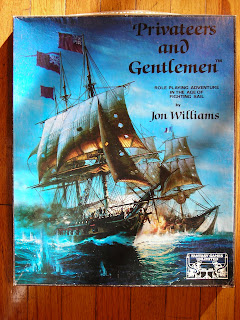
Cover of Privateers and Gentlemen, published by Fantasy Games Unlimited.

Privateers and Gentlemen, published by Fantasy Games Unlimited in 1982, is a game of "Role Playing Adventure in the Age of Fighting Sail" wherein "The world of Horatio Hornblower and all the naval heroes of fact and fiction is thoroughly dealt with in three volumes of rules."

As it states in the first volume, Promotions and Prizes:

PROMOTIONS AND PRIZES is a historical role-playing game. Each player will take the part of a naval officer of the period 1755-1815, attempting to rise in rank and affluence through a series of naval battles, raids, skirmishes, and captures... meanwhile avoiding any number of horrible deaths, diseases, amputations, courts-martial, or perhaps being shot by a firing squad like Admiral Byng.

Here is my first character for Privateers and Gentlemen:

Name: Captain Barrington Dalrymple, Privateer

Strength: 16
Sense Acuity: 13
Mass: 11
Constitution: 15
Intelligence: 15
Dexterity: 8
Intuition: 12
Charisma: 11

Strike Bonus: +20%
Shoot Bonus: +5%
Parry Bonus: nil

Languages: 3 (including native tongue): English, French, Spanish
Handedness: right-handed
Social Level (of father): Gentleman (roll of 79)
Legitimacy: Legitimate
Position: First Son
Father's Health: Alive
Allowance: 25 pounds
Patrimony: 1000 pounds + Respectable Estate and House
Privateer Background: Smuggler + Merchant Captain

Gunnery: +15%
Sailing Ability: -5
General Seamanship: +10%

Astronomy: 15
Biology: 1
Carriage Driving: 14
Chemistry: 1
Climb: 10 (raised from 8)
Dance: 8
First Aid: 7 (raised from 4)
Forgery: 12 (raised from 4)
General Knowledge: 7 (raised from 4)
Geology: 1
Haggle: 13
Hide: 15
History: 15
Law: 7 (raised from 4)
Literary Gent: 4
Lockpick: 4
Make Speech: 17
Mapmaking: 15
Mechanics: 3
Move Quietly: 12 (raised from 8)
Play Instrument: 0
Pick Pocket: 1
Ride: 8
Shipwright: 15
Sing: 13
Swim: 10 (raised from 2)
Weather Prediction: 15
Write Own Language: 15
Write Foreign Language: 3

Character creation in Privateers and Gentlemen is of moderate complexity. The eight attributes are generated by rolling 3D6 for Strength, Sense Acuity, Mass, Constitution, Intelligence, Dexterity, Intuition, and Charisma. If the character's attributes are hopeless, the player may, with the referee's permission, roll again or even roll three characters and choose the best. I opted for the latter and selected the third character. Three tables are consulted to determine one's Strike Bonus, Shoot Bonus, and Parry Bonus based on three or four of a character's attributes.

Skills begin with starting abilities based on a variety of factors. Some will be equal to a character's attribute, some will start with a random roll such as a D10 or D20, some will be calculated by multiplying an attribute by .5 and adding D10 or just averaging two attributes, and others will be static numbers such as 1 or 4. After these are determined, the player may then spend points to improve any skill chosen using a pool of points equal to the character's Intelligence plus the rolled result of the character's Social Level divided by 5. In my case, this was 31 points, and I immediately spent 8 points on Swim (for which I had rolled a starting ability of 2).

Several specific naval skills are modifiers based on a character's Intelligence and are determined by consulting the relevant table. These are Gunnery, Ship Quality (known as Sailing Ability on the character sheet), and General Seamanship. The number of additional languages a character may start with is also based on Intelligence and ranges from 0 to 3.

Other facets of the character are determined by making percentile rolls on various tables including Handedness; Social Level (of one's father); Legitimacy; Position (in the family); various aspects of one's father's health, past service, and past rank; Allowance (yearly); and Patrimony.

Next, the character's earlier career must be decided. If the character begins as a naval officer, the player will participate in a simple character creation mini-game reminiscent of classic Traveller wherein it will be learned how old the character is, whether they were wounded or succumbed to any diseases, whether they were noticed by a superior officer, whether their naval skills improved, whether they were promoted, and how much prize money they were awarded. If the character begins as a privateer, the player simply rolls on the Privateer Background table, which modifies the character accordingly. I decided my character would be a privateer and result of my roll was "Smuggler + Merchant Captain."

SMUGGLER: The character will know very basic seamanship, and will also have intimate knowledge of 1D4 'smuggler's havens' on a friendly coastline, plus 1D4 smuggler's havens on the enemy coast. Will know the smugglers' underground in his own and the enemy's country, and will be able to gain intelligence from it. On a roll of 81-100 the smuggler has also become known to the authorities, who will be watching for him.
MERCHANT CAPTAIN: Will know basic seamanship plus navigation, stowage, and so on. Roll twice to see if the character can improve his Sailing Quality and General Seamanship scores (see Intelligence Scores for midshipmen, above). Will also have an intimate knowledge of commercial circles in his own and other countries. Due to his knowledge of trade routes, he may add 1 to his die roll on the Encounter Chart.

If I were to play this character in an actual game, I would provide the details of his birthplace, his path to a life of smuggling and privateering, and his interests and motivations, but that would require more research and time than I can afford at the moment. The character has potential, though, and I think I would enjoy portraying him.

You might say Privateers and Gentlemen is to the Horatio Hornblower novels what Flashing Blades is to The Three Musketeers, and that's not a bad thing.

[For more articles in this series, visit How to Create a Swashbuckler.]

12 December 2021

The Adventures of Sir Lancelot (1956-1957) Reviewed

William Russell as Sir Lancelot wielding a sword.

For the purposes of any Theoretical Swashbuckling review, I generally approach any adaptation as a unique work unto itself, more or less. This is true whether it's a movie adapted from a novel or, in the case of The Adventures of Sir Lancelot, a television show adapted from multiple poems that were adaptations of still older poems that were adaptations of legends that were based on early medieval history. There have been many versions of Sir Lancelot from a variety of sources, so, instead of trying to match this one (or indeed any other aspect of Arthurian legendry) with any preceding it, I'll take it at face value, anachronisms be damned.

Consisting of 30 episodes that originally aired in 1956-1957, first in black & white and then in color, the adventures begin with Lancelot's arrival in Camelot where he seeks a place at King Arthur's Round Table. The famous affair with Queen Guinevere is never more than hinted at with the briefest of exchanged glances in the early episodes because the emphasis is on chivalry, justice, and (naturally) adventure. One can reliably expect to see horses, swordplay, a bit of humor, and a moral.

Apart from the obvious and inevitable departures from historical and literary accuracy (neither of which were ever in agreement anyway), the most frustrating liberty taken by the show was the utter de-magicking of Merlin. Perhaps it was a purely practical decision. After all, it would cost far less to depict him doing stage magic and astronomy (and sending messages via carrier pigeon) than to depict him working wizardry of the supernatural sort. Besides, it allows for Sir Lancelot to be the smart knight who is in the know about Merlin's supposed sorcery. Perhaps it was a requirement by certain censors that the show demonstrate educational value, which would preclude spell-flinging in favor of the implementation of the discoveries of Archimedes or the prediction of eclipses. Regardless of the reason behind making Merlin a natural philosopher with a fondness for magic tricks instead of the wisest and mightiest wizard in the world, I find any excuse weak when the knights speak of actually fighting dragons (as they do in a later episode).

The budget for The Adventures of Sir Lancelot was probably modest as may be surmised by the re-use of sets for different locales, the re-use of actors for different characters (e.g. Derren Nesbitt played 14 different characters in as many episodes), and a castle gate that required mounted knights to duck their heads when passing through it. The combat scenes are neither elaborate nor convincing, which serves the dual purpose of being inexpensive and inoffensive. There are never more than a few villagers or knights or bandits or monks on the screen at one time, and the aforementioned dragons are never more than alluded to in conversation.

To be clear, The Adventures of Sir Lancelot is not a romantic epic; it is an episodic adventure series with nominal educational value primarily aimed (I assume) at schoolchildren. It is not without its charms for an older audience, but for those with a taste for more than mere nostalgia, I would hold up one episode in particular for appreciation: "The Thieves." In this episode, first Sir Lancelot and then King Arthur are confronted with the question of, to put it simply, criminal reform. In order to investigate the truth of the allegation that current methods make it impossible for a former criminal to take up an honest life, King Arthur and Sir Lancelot disguise themselves as commoners and see, for the first time, how the underprivileged survive. This is also the one and only time that King Arthur is depicted not solely in his capacity as a ruler, but as a human being. It is a poignant story well acted, and if more of the episodes were like this one, The Adventures of Sir Lancelot would have had an enviable and long-lasting reputation as a television classic of rare quality.

Writing: Fair
Directing: Fair
Acting: Good
Cinematography: Fair
Stunts: Fair
Swordplay: Mediocre
Panache: Good

Overall Rating: Fair
Swashbuckling Rank: Fair

Written by: various
Directed by: various
Performed by: William Russell, Cyril Smith, Robert Leigh-Hunt, Robert Scroggins, David Morrell, Derren Nesbitt, Jane Hylton, et al.
Cyril Smith as Merlin looking upwards.

14 November 2021

The Curse of Capistrano

Cover of All-Story Weekly featuring The Curse of Capistrano.

The Curse of Capistrano by Johnston McCulley is the first story of Señor Zorro, originally appearing in the pulp magazine All-Story Weekly in 1919. It was rapidly adapted to film by Douglas Fairbanks in The Mark of Zorro (1920), which provided the alternate title for its source when it was released as a novel. Zorro is arguably North America's first fictional swashbuckling hero, influenced by both the legends of Robin Hood and The Scarlet Pimpernel (a novel penned by Baroness Emma Orczy in 1905 from the play written by her and her husband, Henry George Mantagu MacLean Barstow in 1903). The novels and movies of Zorro would, in turn, beget an entire genre of adventure fiction from The Shadow to The Green Hornet to Superman and, of course, Batman.

Apart from its profound influence on popular culture, The Curse of Capistrano (or The Mark of Zorro if you prefer) is simply a damned fine romantic adventure story with all of the elements necessary for a good swashbuckling tale. It maintains an elegant balance of the legendary and the human, the melodramatic and the comedic, the daring and the whimsical. The pacing is superb, the characters have substance, and there are moments when one can almost feel the swell of music in one's soul. This is a novel that did not disappoint this lifelong fan of Zorro. I recommend it in friendship to those with the heart of Zorro.

22 September 2021

How to Create a Swashbuckler in Zorro: The Roleplaying Game

Cover art of Zorro: The Roleplaying Game, published by Gallant Knight Games.

Zorro: The Roleplaying Game, published by Gallant Knight Games in 2020, "gives you all the tools and information you need to experience the swashbuckling, dramatic, and cinematic action of the legends and stories of Zorro!"

The burb on the back cover continues;

Players will be able to work alongside Zorro as part of Zorro's Legion, or even take on the role of the legendary hero! The book is rife with details about Zorro's adventures in Alta California, as well as providing rules to emulate the legendary actions of this masked hero of the people.
Featuring two full adventures, a solo adventure, numerous adventure seeds, 15 templates for characters, character creation, and a full bestiary of foes and animals, this high-paced game is powered by the newest edition of the D6 System from legendary publisher West End Games!

Zorro: The Roleplaying Game offers two ways to create a player character: templates and full customization. In the first method, the player selects a template complete with attributes, equipment, background, and personality. The player provides the character's name and description and distributes 7D (seven six-sided dice) amongst the character's skills. Templates include:

  • Faithful Friar/Sister
  • Enterprising Local
  • Brave Doña/Don
  • Brash Soldado
  • Sniveling Don/Doña
  • Sneaky Sister/Friar
  • Thieving Scum
  • Rabble-Rousing Rebel
  • Clever Horse-Trainer
  • Nervous Bandit
  • Scheming Scholar
  • Stalwart Doctor
  • Military Maestro
  • Experienced Cavalier
  • Charming Musician

Creating a customized character involves more steps, but is a simple process. Distribute 12D amongst the five attributes. No attribute may be lower than 1D nor higher than 4D. Distribute 7D amongst the character's skills. No skill may be higher than 2D. Defense numbers are then calculated: Dodge equals Perception x 5; Parry equals Agility x 5. Name the character, describe the character, compose a brief background, and select equipment.

Both methods are equally valid, but for the purpose of this article I shall choose full customization.

Compadres, please meet my first character for Zorro: The Roleplaying Game:

Name: Gustavo Lobo

Idealistic Poet

Agility 3D
      Melee 1D
Brawn 2D
Knowledge 3D
      Languages 1D
      Scholar 1D
Perception 2D
      Driving/Riding/Piloting 1D
      Investigation 1D
Charm 2D
      Persuasion 1D
      Willpower 1D

Dodge 10
Parry 15

Languages: Spanish, Nahuatl

Equipment: Fancy clothes, journal, sword, 100 dinero

Background: Gustavo Lobo is the son of a don and doña. He was educated in Spain where he acquired a love of literature, philosophy, and duelling. Upon his return to the New World, he embarked on a journey across Mexico where he learned the language and some of the surviving literature of the Aztecs. Equally motivated by art and justice, he has devoted himself to fighting oppression, preserving culture, and inspiring others.

Appearance: He is a man in his twenties with lively eyes and dark hair (already tinged with gray) that tends to flare out at the sides like a flame. He is of medium build and average height with broad shoulders.

Zorro: The Roleplaying Game has an intuitive, streamlined approach to character creation and an action resolution system to match. The skill system is focused on the likely activities of swashbuckling heroes and their enemies, which prevents the rules from being ungainly. I think it's a well-executed refinement of the D6 System, and I hope they use it to good advantage in adapting other swashbuckling genres. I can't wait to run this game.

[For more articles in this series, visit How to Create a Swashbuckler.]

19 September 2021

Talk Like a Pirate in the Year of Our Lord Twenty Hundred and Twenty-One

'Tis International Talk Like a Pirate Day, which I nearly missed on account of being marooned on this metaphorical desert isle where nary a message of piratical origins has reached this wretched soul for longer than I can recollect. When have I last crossed cutlasses, fired a cannon, or buried any treasure? I cannot say, but it has been far too long, arr, far too long. I hope this message, tucked in an empty rum bottle, finds ye well, and I well hope ye can find me here whilst I'm still amongst the living and not a pile of sun-bleached bones.

17 August 2021

Flashing Blades Overview Over There

I am always happy to find others writing about swashbuckling role-playing games, so I would like to direct my readers to [Obscure Games] Flashing Blades, an overview of Flashing Blades in The Ongoing Campaign by faoladh.